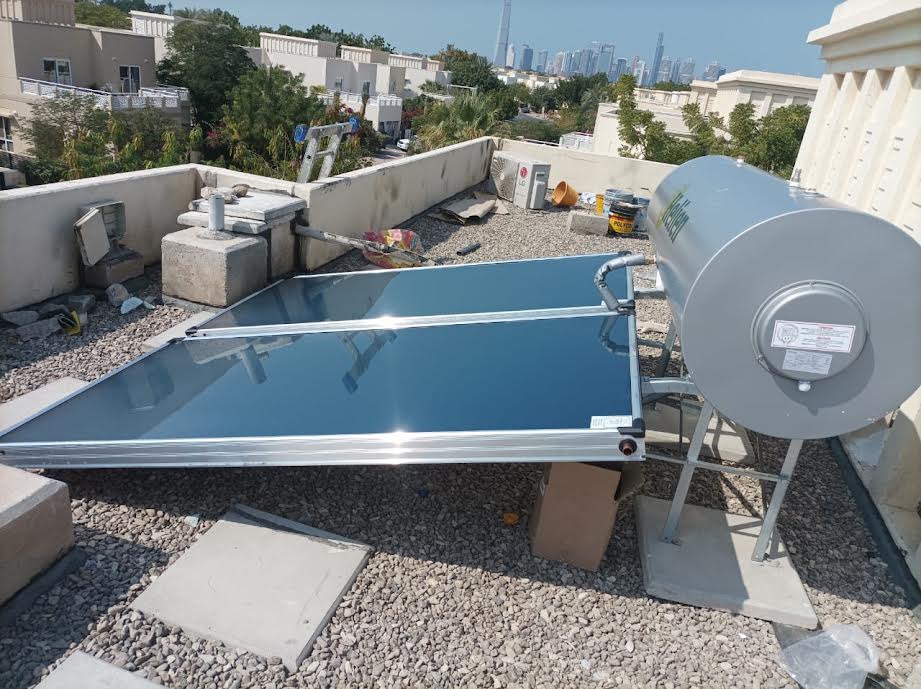
Solar Panels Dubai: Why Switching to Solar is Your Smartest Investment


Dubai receives more than 3,500 hours of sunlight each year. That is not just a climate statistic. For homeowners considering a villa renovation, it is one of the most compelling arguments for thinking about solar at the same time as you think about your roof, your M&E systems and your long-term running costs.
Solar panels are increasingly common across Dubai's residential communities. The technology has matured significantly, the economics have improved, and the integration of solar into a renovation project, rather than as a separate installation after the fact, tends to produce a cleaner, more considered result. Here is what is worth knowing.
Why Dubai is particularly well-suited to solar
The numbers are straightforward. With an average of more than 3,500 hours of direct sunlight annually, a well-positioned solar installation in Dubai will generate meaningful energy output year-round, not just in summer. Panel efficiency has also improved considerably in recent years, and modern systems are designed to perform in high-heat environments where older technology would lose efficiency.
The result is a system that can realistically offset between 50 and 70 percent of a household's electricity consumption, with some installations generating more than the household uses. That surplus, under DEWA's Shams programme, can be fed back to the grid and credited to future bills.
DEWA's Shams programme
The Shams Dubai programme allows homeowners to connect solar panel installations to the DEWA grid. Any excess electricity your system generates beyond what your home consumes is exported to the grid, and the credit accumulates against your future DEWA bills. It is a well-established scheme that meaningfully changes the financial case for residential solar in Dubai.
Registration and technical compliance requirements apply, and any installation intended for grid connection will need to meet DEWA's specifications. This is worth factoring into the planning process, particularly if solar is being considered as part of a broader renovation.
Integrating solar into a villa renovation
The most efficient time to consider solar panel installation is during a villa renovation, particularly one that involves roof works, structural changes or an upgrade to the home's electrical systems. Integrating solar at this stage means the roof structure, cabling routes and electrical panel capacity can all be considered together, rather than retrofitting a solar installation onto a finished home where access and aesthetics both become more complicated.
If you are planning a villa renovation and want solar to be part of the outcome, the conversation about panel placement, roof load, inverter location and electrical integration is one that should happen in the design phase, before the construction programme is fixed.
Maintenance and lifespan
One of the practical advantages of solar in Dubai is the relatively low maintenance requirement. Quality panels are built to withstand the heat, sand and UV intensity of the Gulf climate and are typically warranted for 25 years or more. The main ongoing requirement is periodic cleaning to remove dust accumulation, which can affect output if left unaddressed. In Dubai's environment, a light clean every few months is generally sufficient to maintain performance.
The impact on property value
Solar installations are increasingly valued in Dubai's residential property market. A villa with a functioning solar system and an established track record of reduced DEWA bills is a demonstrably more economical property to run. As energy costs and sustainability considerations become more prominent in buyers' thinking, this is only likely to become a more significant factor at sale.
What to think about before you proceed
Roof orientation and shading: south and west-facing roof surfaces with minimal shading perform best in Dubai.
Available roof area: a typical residential installation requires between 25 and 50 square metres of usable roof space depending on the system size.
Current and planned electrical load: your expected energy consumption determines the system size you need.
DEWA connection requirements: if grid connection is the goal, technical compliance with Shams programme specifications needs to be built into the installation from the start.
Integration with renovation works: if structural or roof works are planned, coordinating solar at the same time is almost always more efficient and cost-effective than treating them separately.
If you are planning a villa renovation in Dubai and want to think about how solar could be integrated into the project, we are happy to discuss how it might work alongside the construction programme. Our team has experience coordinating specialist installations within broader renovation projects and can advise on timing, sequencing and what to ask a solar specialist.
Contact us to arrange a consultation.